How AI in Auditing Helps Audit Firms Stay Competitive in 2026
.png?width=1400&quality=90&format=avif&crop=fit)
Key takeaways
- In audit, competitive advantage in 2026 is a capacity problem. Firms that handle more work at the same headcount win.
- AI's ROI concentrates on specific, high-volume procedures: testing and reconciliation, long-document review, and client evidence collection.
- AI audit tools built for audit workflows are reducing individual procedures by up to 85% and saving firms thousands of hours.
- The efficiency gap between AI-enabled firms and fully manual ones is widening, not stabilizing.
- Management support for AI adoption has nearly doubled since 2025, but only 13% of firms have fully integrated AI into defined workflows. The firms closing that gap are pulling ahead.
- AI Governance is now part of the competitive equation. Firms with traceable outputs, clear AI ownership, and audit-ready evidence are operating at a different standard than those without.
It is, in a way. And the firms that have reached that point are competing differently from those that haven't.
Why AI-enabled audit firms win more business
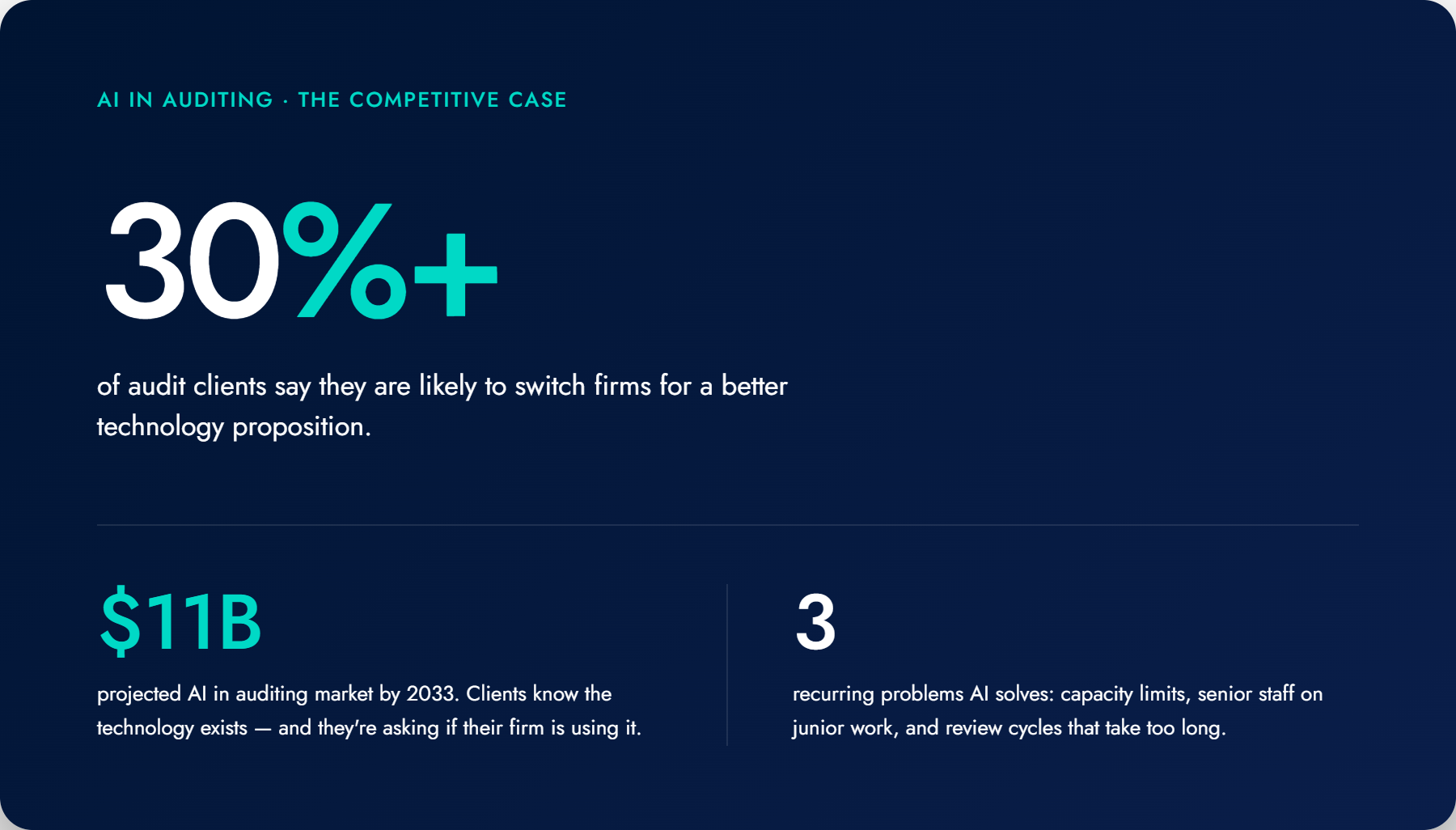
For most audit leaders, competitiveness shows up in specific, recurring problems: not being able to take on more clients because the team is already at capacity; senior staff spending hours on work that should sit at a junior level; review cycles that drag on longer than they should.
When auditors spend less time hunting for evidence across 100-page PDFs or manually cross-referencing hundreds of transactions, they spend more time on higher-value work.
The gap between early adopters and everyone else
The efficiency gap between firms running purpose-built AI workflows and those still working fully manually is not narrowing. It's widening.
That gap shows up in proposal conversations, in the ability to take on more clients, and in hiring. 77% of audit and finance professionals say AI access affects whether they stay at an organization. Retention, in a profession where experience is a direct input to audit quality, is a competitive issue.
The challenge most firms face isn't intent. Across the profession, 75% say their organization actively supports AI and 73% say it invests to remain competitive. The problem is execution. Firms that treat AI as a priority without building governance, workflow integration, and clear ownership are saying "this is important" without providing the infrastructure to act on it.
The ROI of AI in audit: cutting testing time from 45 to 5 minutes
Where AI delivers the most ROI in audit
The highest-value AI applications in audit happen when there’s logic of audit and finance workflows, and they are applied where auditors already work.
Collection
Testing and reconciliation
Because Excel Agents work natively inside Excel and follow existing working paper templates, adoption doesn't require changes to firm methodology. Customers using Excel Agents report an 85% reduction in manual work on top of what DataSnipper's platform already automates. Use cases include batch payment testing, approval matrix testing, royalty calculations, and access control testing, each producing audit-ready evidence with every action documented before sign-off. See how Excel Agents work in action:
Document review
Across all three workflow categories, every agent action is traceable. Inputs, logic, and outputs are visible before sign-off, which is the baseline requirement for defensible audit evidence.
The gap between early adopters and everyone else
The efficiency gap between firms running purpose-built AI workflows and those still working fully manually is not narrowing. It's widening.
That gap shows up in proposal conversations, in the ability to take on more clients, and in hiring. 77% of audit and finance professionals say AI access affects whether they stay at an organization. Retention, in a profession where experience is a direct input to audit quality, is a competitive issue.
The challenge most firms face isn't intent. Across the profession, 75% say their organization actively supports AI and 73% say it invests to remain competitive. The problem is execution. Firms that treat AI as a priority without building governance, workflow integration, and clear ownership are saying "this is important" without providing the infrastructure to act on it.
The picture for 2026 in audit and finance and beyond
The changes underway in audit go beyond automation of individual procedures. Data volumes are growing, reporting cycles are compressing, and expectations from regulators and clients are rising simultaneously. The FRC has published AI guidance. Clients are evaluating firms in part on their technology proposition. And the talent market is watching what kind of work firms offer.
If you're thinking about where your firm stands and what the next step looks like, it's a useful place to start.


.svg?width=600&quality=70&format=auto&crop=16%3A9)