Top 5 Takeaways from Connect 2026 London
Firms are kickstarting pilots and getting real management buy-in to ship AI solutions, we've been calling it the 'support surge.' The direction is clear. But confidence hasn't kept pace. Pilots are showing inconsistent results, and the 29-point gap between partners and practitioners tells you exactly where the friction lives: not in the boardroom, but on the ground. We brought together customers and practitioners from across Europe for two days across three talk tracks: Trusted AI Evidence, The Technology-Driven Firm, and The Augmented Auditor.
Who's accountable when an agent does the work? How do you move fast without breaking governance? What does this profession look like in three years?
Here's what came out of the room.
Auditors are becoming the architects of the next era
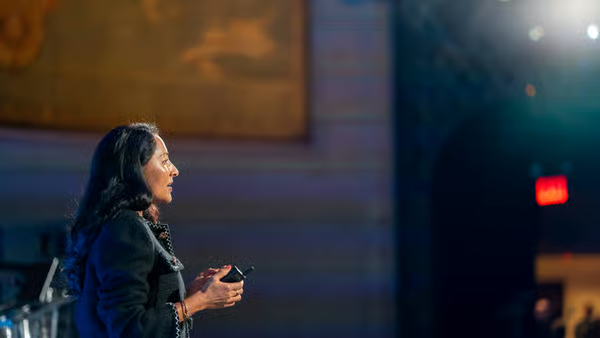
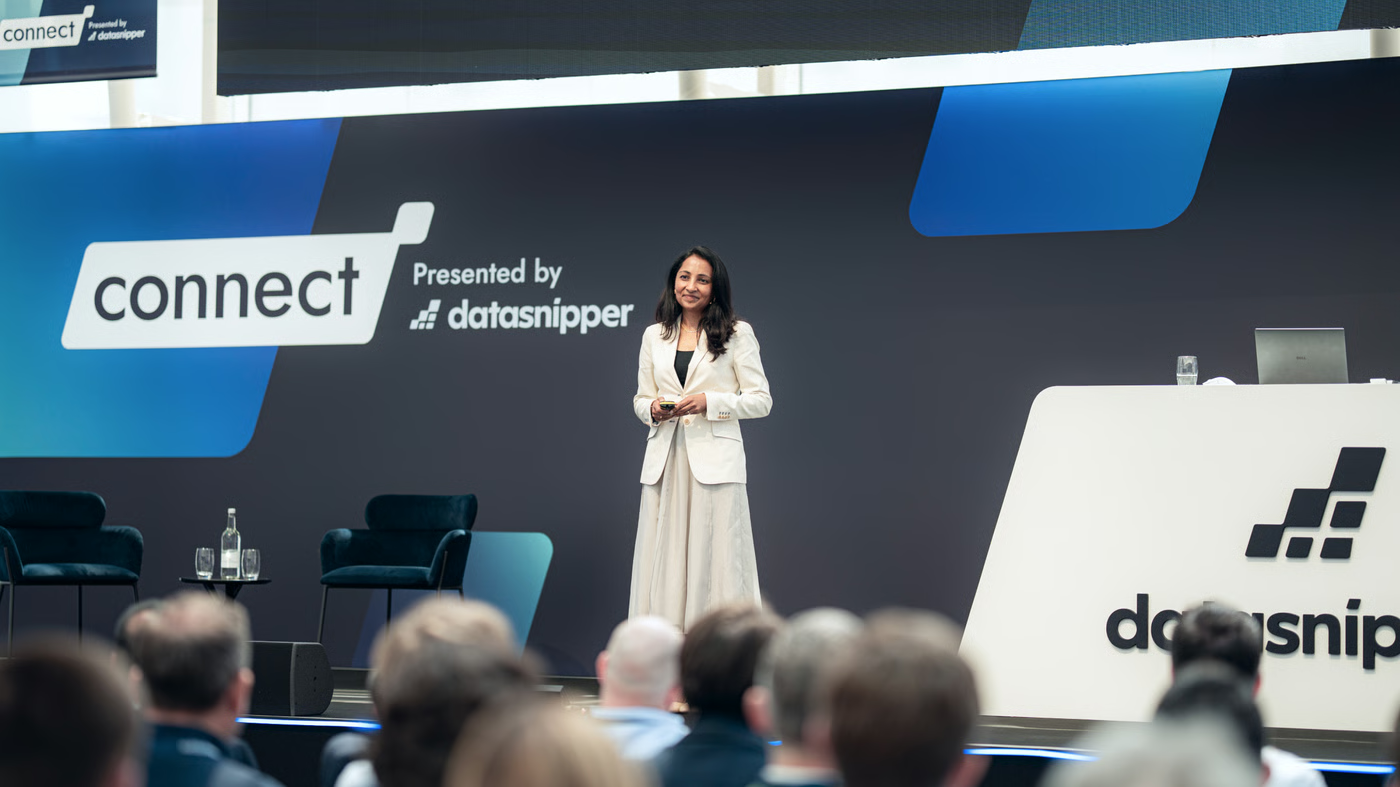
Our CEO Vidya Peters opened Connect London '26 with a reframe that ran through both days. Audit teams sit in a position most industries don't. They understand the workflows, they own the standards behind the evidence they're presenting, and regulators hold them accountable regardless of whether or not they used technology to do the majority of the work. This makes them the architects of how AI gets built into the profession and allows them to continue to safeguard our trust in financial systems world-wide.
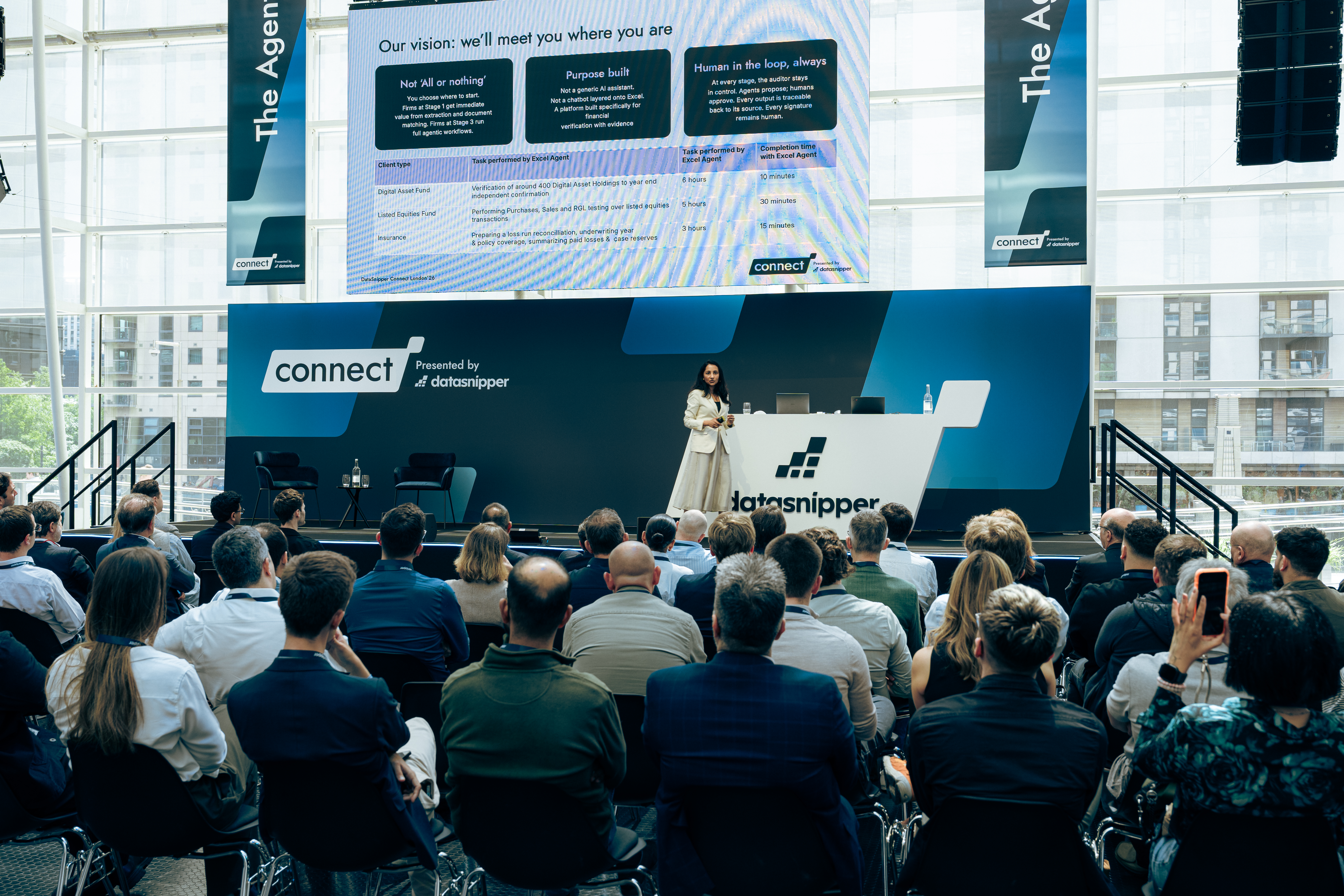
Vidya Peters opening Connect 26' London, setting the stage.
There are four specific risks that Peters pointed out with unchecked AI in audit:
- AI slop
- Unreliable outputs: probabilistic systems that generate plausible answers rather than verified ones
- A confidence gap: where a model's certainty tells you nothing about its accuracy
- Shadow use: teams running AI tools outside firm governance because no approved option exists.
Most firms in the room, Peters suggested, are operating between Stage 1 and Stage 2 while believing they are closer to Stage 3. The gap between perception and reality is where governance breaks down.
The agentic firm is here
Thilo Richter, our VP of Product and Engineering at DataSnipper noted around three questions every firm is really asking when they evaluate AI: will it be correct, can we defend it, and do we get a return.
For example, Uber burned its entire 2026 AI coding budget in four months. Salesforce spent roughly $300 million on Anthropic tokens and is now routing work to cheaper models. Shopify told investors gross profit took a hit from "increased LLM cost." Microsoft cancelled most direct Claude licenses as usage costs exploded. Horizontal AI platforms can be extraordinary to build on, Richter noted, if you have the engineers, the governance, and the context layer to make them economical. Most audit firms don't. Purpose-built matters.
.jpg)
Thilo Richter speaking at Connect 26' London in his product keynote.
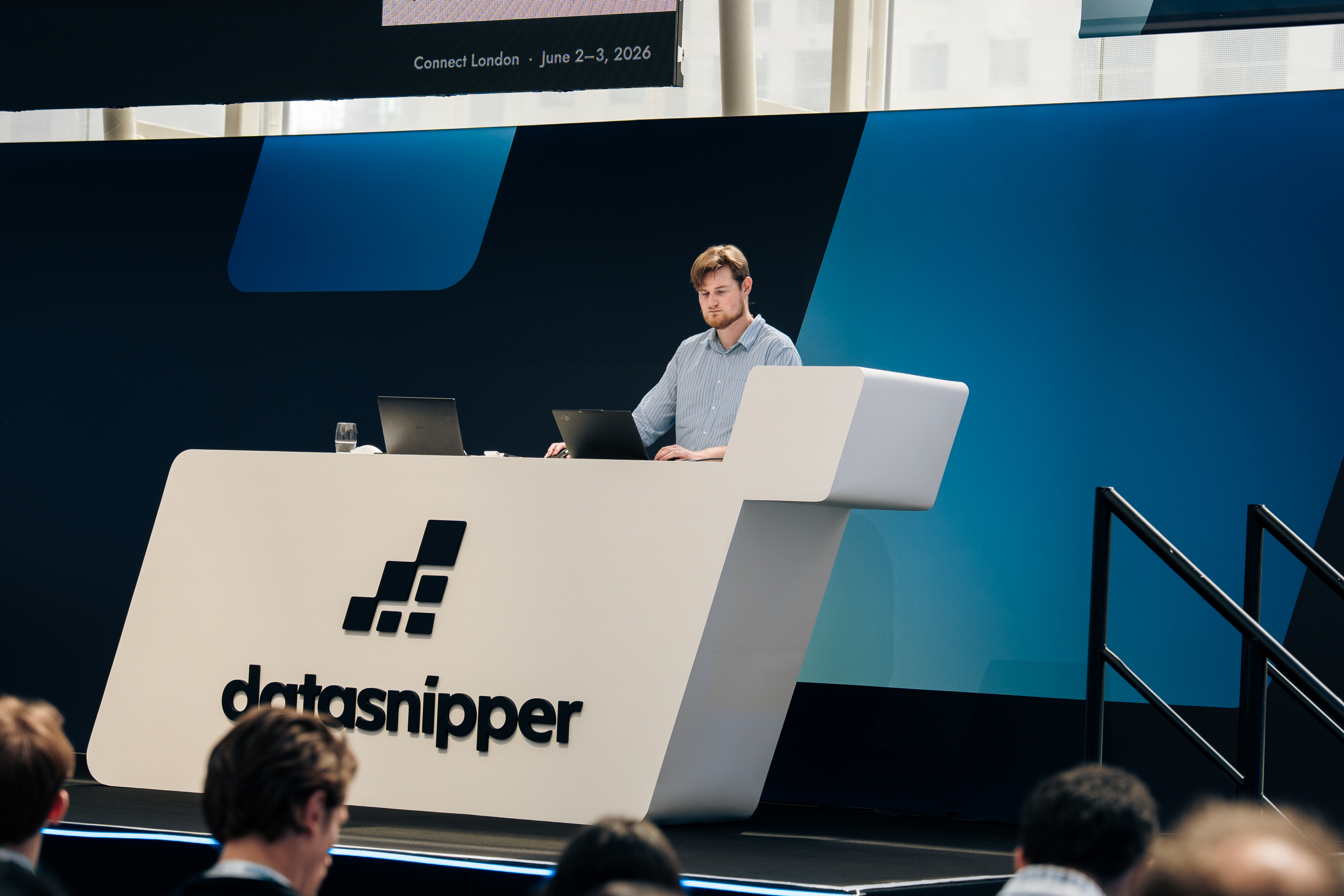
Vincent Damen speaking at Connect 26' London running a live demo of Excel Agents.
On trust, Richter was direct: no agent is 100% accurate. The question for audit teams isn't whether to trust the output. It's whether you can check it, and how long that takes. Every DataSnipper agent output is connected through Snips, with full visibility into reasoning and reproducible workpapers.
That's what makes it defensible.
The FRC has told you what it expects. Most firms haven't read it.
Ramana McConnon, Head of Assurance Technology at the UK's Financial Reporting Council (FRC), closed Day 1 with a session that should sit on the desk of every audit partner in the room: a detailed walkthrough of the FRC's newly published guidance on generative and agentic AI in audit. The guidance draws a line most firms haven't fully processed yet.
Human accountability doesn't change when an agent does more of the work. The auditor who signs the opinion still owns the judgment behind it. The FRC has categorized AI-enabled audit procedures by risk level and published expectations for what testing, certification, and system design need to cover before any of those procedures can be relied upon.
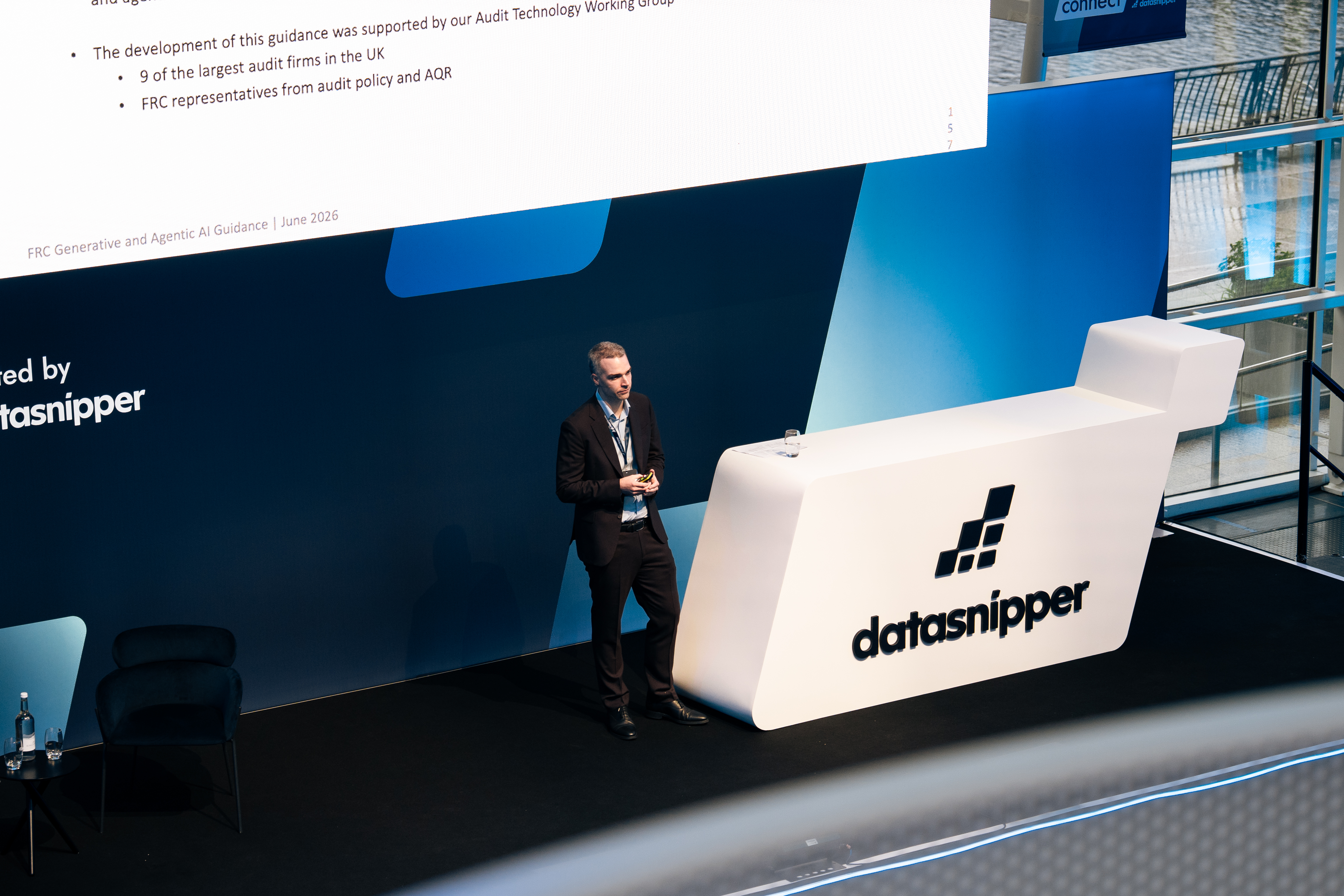
Ramana McConnon speaking at DataSnipper Connect 26' London
The practical question McConnon left the room with: does your AI governance framework reflect what the FRC expects today, or what you assumed they'd eventually ask for?
Firms waiting for regulatory certainty before acting already missed the window. The guidance is out. The question is whether your internal processes are built to meet it.
How much of the workflow should AI own
On one side: the case for keeping humans meaningfully in the loop at every significant step, on the grounds that professional skepticism requires the auditor to have engaged with the evidence, not just approved it.
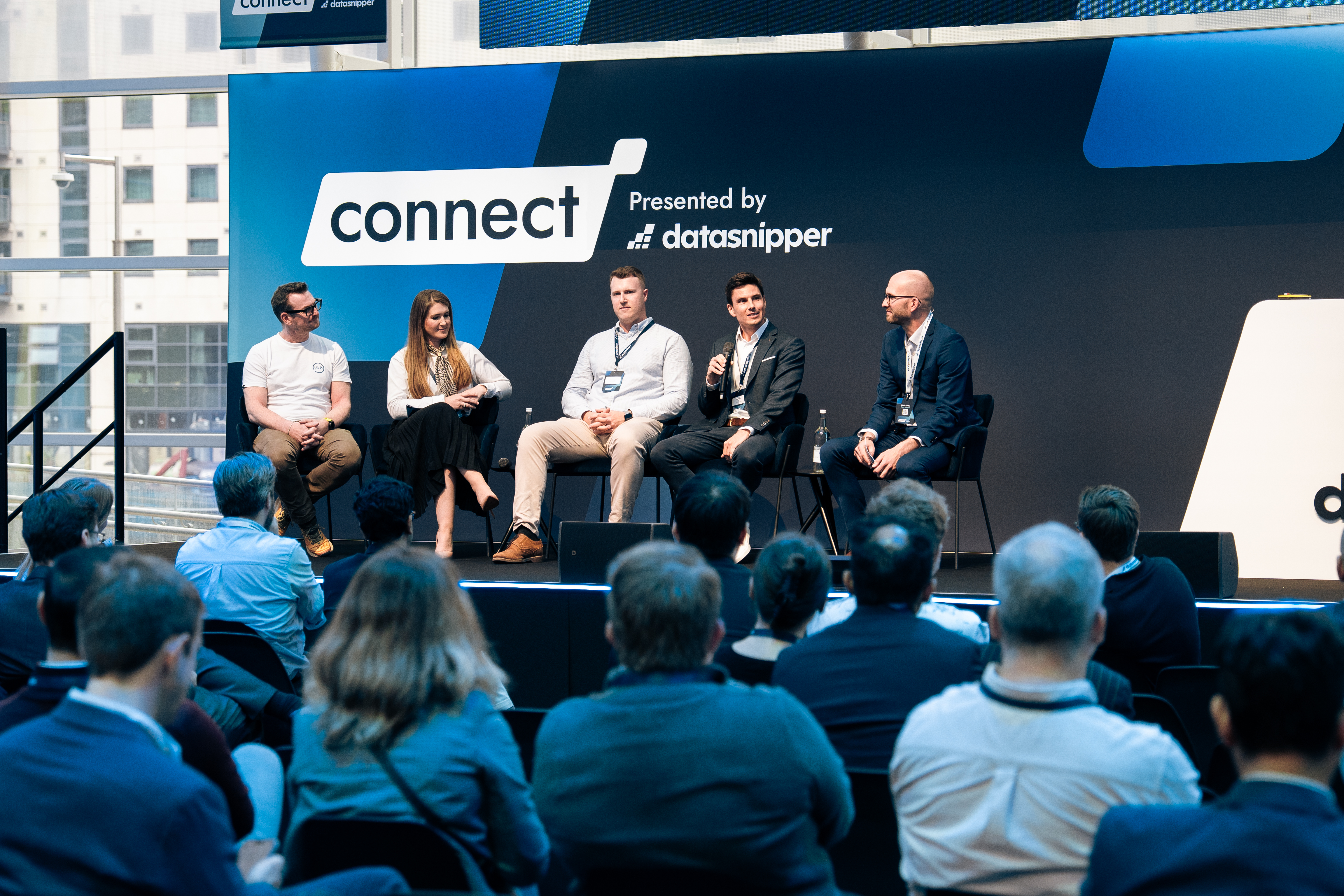
Closing debate moderated by Dirk van Portfliet with customer panelists John Toon, Head of Technology at HLB, Bronwen de Abreu, Technical Director, Audit Data & Analytics at MHA, Adam Passmore, Senior Manager at RSM Cayman Ltd., and Lorenz Neu, Partner at Dr. Kleeberg & Partner GmbH WPG StBG
However, the argument that end-to-end AI ownership of defined, low-judgment workflows produces faster, more consistent, more auditable results than hybrid approaches that create accountability gaps between what the human did and what the agent did.
The real takeaway was the framework for making the decision yourself: risk level of the procedure, maturity of your governance, and whether your team can credibly defend the output if a regulator asks who made the call.
A clearer stance on AI is happening: 2026 and forward
The firms in London came to with real problems: governance questions, rollout decisions, talent gaps, regulatory pressure. They left with a clearer picture of where auditors and finance professionals, technology and growing trends are heading.
Here are some of the insights from our speakers that we'll be taking with us:
"AI is reshaping how we develop accountants. It has an impact on development of our people. Career paths are evolving, and that's an opportunity. The real question now is: how do we build the right skills in our people?" - Gert Jan Brouwer, CROP Accountants
"Map the gap between what the technology actually does and what it is claimed to do. Audit needs records. LLMs give you events." - Richard Foster-Fletcher, Independent Analyst and Researcher
"Learning how to teach AI use was interesting. With Agents, it really helped us automate and make a difference. Compared to a lot of other products, DataSnipper is much more tangible and faster to adopt. This tool is powerful."- Aphia Mason, Senior Manager, Standish Management
"A world without human oversight is not efficiency. It is liability. AI is probabilistic, not deterministic. Confident output does not mean correct output. In audit, those two must be the same." - Vidya Peters, CEO, DataSnipper
Whether we like it or not, the auditor's role is expanding into AI governance, evidence standards, firm-wide transformation, and what "trusted" means when a AI produced the output. That's a bigger job than the one most audit teams were hired for. The firms treating it as an opportunity are already pulling ahead.
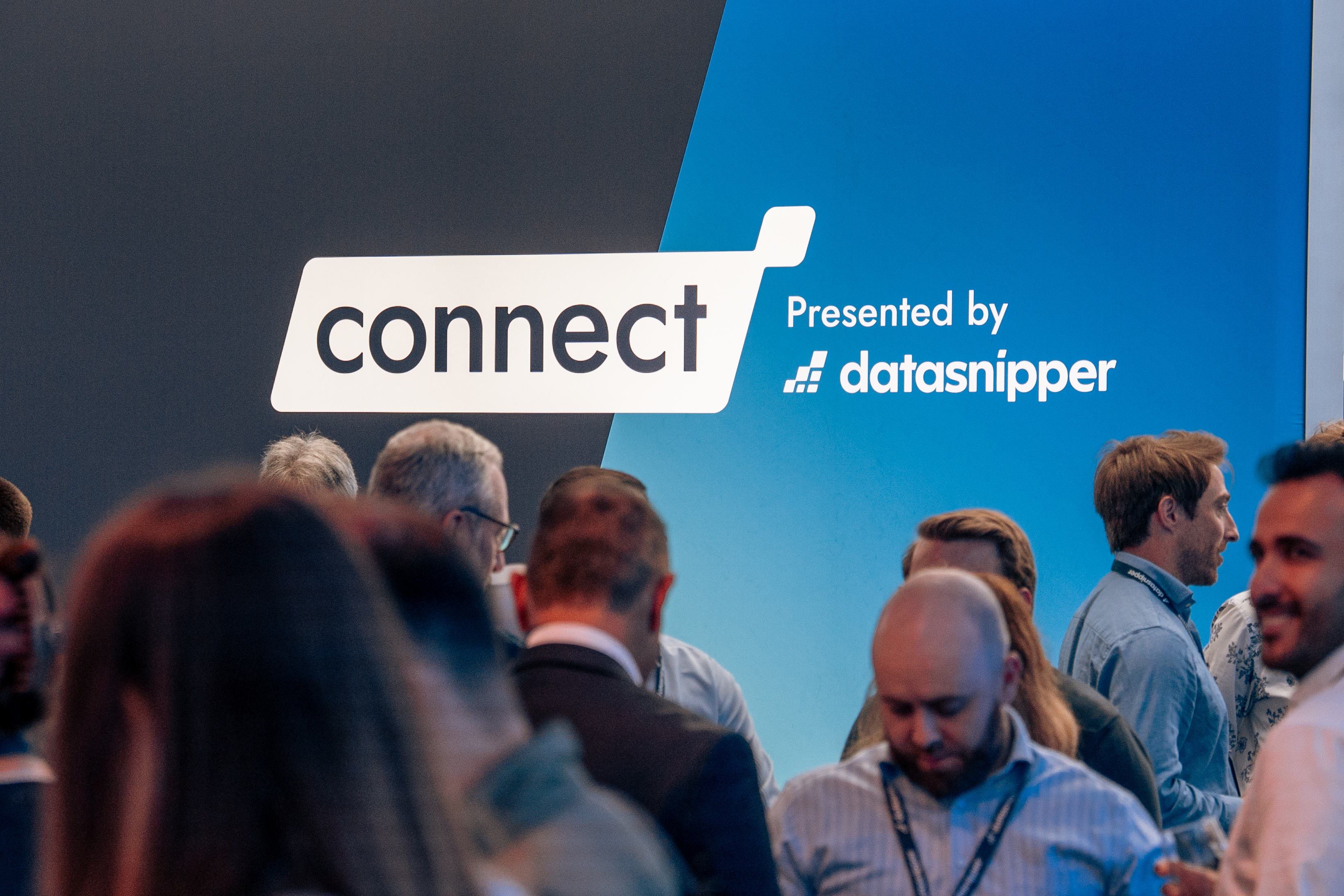
That's a wrap on Connect London '26. Maybe we'll see you at the next one, keep an eye out on our Linkedin for the next edition coming to a city near you.