Should Audit Firms Build or Buy AI? What the Budget Conversation Misses
.png?width=1400&quality=90&format=avif&crop=fit)
Key takeaways
- Building AI for audit costs between $1.1 million and $3.2 million in Year 1, with ongoing operating costs of $390,000 to $890,000 annually.
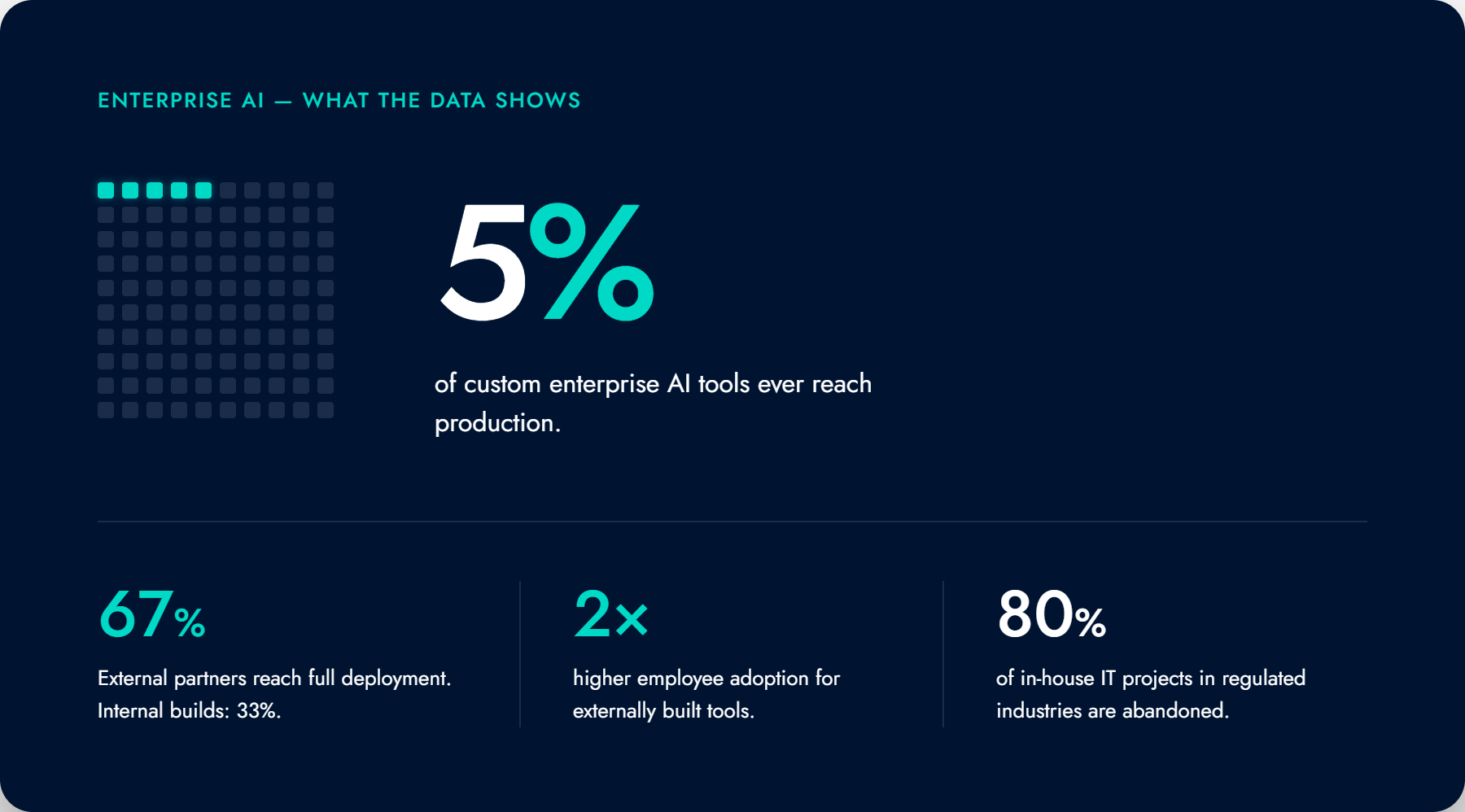
- In regulated industries, as many as 80% of in-house IT projects are abandoned before completion. AI initiatives face similar or greater complexity.
- External partnerships succeed at twice the rate of internal builds.
- LLM pricing is not stable. A workflow priced on GPT-5 costs 24 times more on GPT-5.5 Pro, and firms building on last year’s model pricing are already operating on the wrong number.
- Purpose-built audit AI runs the same document tasks at a fraction of the token cost of general-purpose tools, because domain logic sits in the application layer rather than the prompt.
- The auditor who signs the opinion owns the judgment behind it, whether AI assisted or not. Accountability follows the output regardless of who built the system.
The slide shows the entry cost. Running the system is a different number.
That gap between project cost and operating cost is where most AI build decisions go wrong. This article works through the complete picture: what building AI for audit actually costs, why purpose-built platforms tend to be cheaper per unit of output than firms expect, and how to structure the decision so the number in the board deck reflects what the firm will actually spend.
Why this decision is harder in 2026 than it was in 2023
Modern AI tools make building look accessible. A firm can deploy a custom agent without extensive engineering, connect to a model API in days, and automate a review workflow in weeks. Early results can be impressive: extracting data, checking consistency, flagging exceptions.
A structural gap separates a demo that works from infrastructure that holds.
A workflow that performs well for one user must perform consistently across a hundred. It must produce repeatable output, maintain audit trails, handle permissioning, enforce review hierarchies, and withstand regulatory scrutiny. Each of those requirements must be solved before the system is useful in a professional context.
The deeper challenge is scale. An individual auditor using an LLM brings their own judgment to interpret the output. Turning that into a shared system that enforces consistent methodology across a team introduces governance problems that have nothing to do with audit itself. Someone has to own the platform, maintain it, and be accountable when outputs are questioned. That accountability burden is where build-versus-buy decisions become strategic rather than technical.
What the research shows:
- External partnerships reached full deployment 67% of the time, versus 33% for internal builds.
- Employee usage rates were nearly double for externally built tools.
- 95% of enterprise AI initiatives fail to generate measurable P&L impact, with internal builds failing at twice the rate of external partnerships.
Accessibility creates the impression that production is closer than it is. For most firms, the data suggests otherwise.
What building AI for audit firms cost
Internal build initiatives often begin with an optimistic financial model. Leadership budgets for development and assumes infrastructure will remain manageable. Total cost of ownership is materially higher.
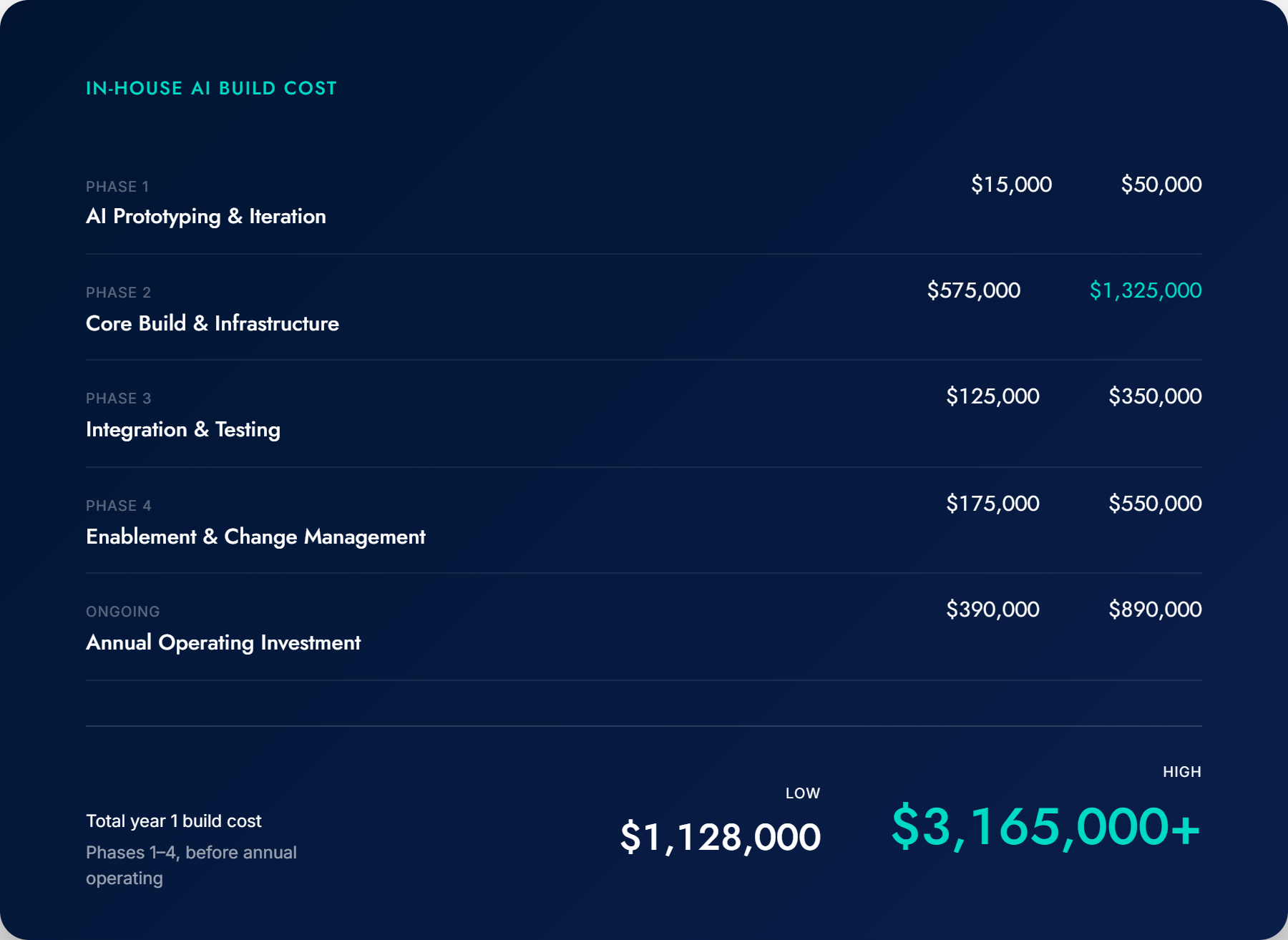
Cost category | Low estimate | High estimate |
Phase 1: AI Prototyping, feedback, and iteration | ||
Requirements documentation and architecture planning | $15,000 | $50,000 |
Phase 1 subtotal | $15,000 | $50,000 |
Phase 2: Core Build and Infrastructure | ||
Infrastructure (extraction, LLMs, vector DB, storage) | $150,000 | $500,000+ |
Engineering (2-3 specialized engineers, fully loaded) | $400,000 | $750,000 |
Compliance documentation and security review | $25,000 | $75,000 |
Phase 2 subtotal | $575,000 | $1,325,000 |
Phase 3: Integration and Testing | ||
Integration into existing tooling (file share, ERP, GRC, AMS) | $75,000 | $250,000 |
Ongoing maintenance and regression testing | $50,000 | $100,000+ |
Phase 3 subtotal | $125,000 | $350,000 |
Phase 4: Enablement, Training, and Change Management | ||
Instructional design and content development | $25,000 | $100,000 |
Documentation and knowledge base buildout | $25,000 | $75,000 |
User onboarding and training delivery | $25,000 | $100,000 |
Phase 4 subtotal | $175,000 | $550,000 |
Ongoing: Annual Operating Investment | ||
People (product manager, designer, engineer) | $260,000 | $500,000 |
Infrastructure (LLM inference, vector database, storage) | $60,000 | $200,000 |
Integration maintenance, security, and training refreshes | $70,000 | $190,000 |
Annual operating subtotal | $390,000 | $890,000 |
Total Year 1 build cost | $1,128,000 | $3,165,000+ |
Firms typically budget $150,000 to $400,000 for an initial AI pilot. The difference between that figure and the $1.1 million to $3.2 million Year 1 reality is not a rounding error, it is the gap between a proof of concept and a production system.
The maintenance problem no one budgets for
Once an AI agent is live, the organization operates a product that competes for engineering capacity with everything else on the roadmap. The maintenance burden grows over time.
What the organization owns permanently after a build:
- Model upgrades and regression testing after each new model release
- Re-prompting when output drifts as underlying models change
- Security documentation updates as compliance frameworks evolve
- Infrastructure patching and monitoring
- Internal support and feature requests from engagement teams
- Knowledge transfer when engineers leave the firm
The questions to pressure-test internally before signing a build budget:
- Who owns this platform in three years?
- Who improves it every quarter?
- Who is accountable when a model update changes how the system behaves?
- Who is accountable when outputs fail a regulatory review?
A vendor dedicated to audit and finance AI carries that burden instead. That vendor invests continuously in model evaluation, user experience, and compliance alignment. The firm benefits from that investment without the internal staffing load.
Why purpose-built audit AI costs less per task
Illustrative cost comparison across common audit document tasks:
Audit task | Generic LLM (estimated tokens per document) | Purpose-built (estimated tokens per document) |
Invoice extraction from a 150-page PDF | 18,000–25,000 | 2,500–4,000 |
Lease agreement review | 12,000–18,000 | 1,500–3,000 |
Board meeting minutes extraction | 8,000–14,000 | 1,000–2,500 |
Generic models must process document structure, field relevance, and applicable standards within each prompt call. Purpose-built systems pre-handle that context, reducing what the model processes and what the firm pays for.
At 50,000 documents per year for a mid-size firm, a 5-to-7x token efficiency difference separates a manageable infrastructure cost from one that surprises the CFO mid-year. The output is audit-grade and the cost is forecastable, rather than a number that spikes whenever adoption grows or a model gets upgraded.
Time to value: the opportunity cost of the 4-to-12-month build
In AI adoption, time to value has direct financial consequences.
Internal build timelines frequently extend from four months to well over a year. Hiring, architectural design, security reviews, integration work, testing cycles, and change management all add friction before the first auditor sees a working tool.
.png)
Approach | Typical deployment timeline | When value compounds |
Internal build | 4–12+ months | After deployment |
Purpose-built platform | 2–6 weeks | Within the first engagement |
A verticalized AI for audit platforms deploys in weeks because governance, permissions, workflow controls, and domain logic are already built in.
Every month spent in development is a month without adoption, without compounding efficiency, and without the operational improvements that justified the investment.
Quantifying the delay:
For a team of 50 auditors recovering two hours per person per day at a fully loaded rate of $75 per hour: $7,500 per day in recovered capacity. Over a 9-month build cycle, the unrealized return exceeds $2 million. That figure does not appear in any build proposal.
Audit AI accountability and the regulatory exposure behind it
In regulated industries, the accountability question is a legal and professional exposure issue.
Generic AI models are probabilistic. They generate outputs based on likelihood, which works for many business applications. Audit requires something different: reviewable outputs, documentation that traces directly to source evidence, and results that are consistent across repeated executions.
When an AI system produces a result and the path from source document to conclusion is unclear, that ambiguity has consequences. In regulatory inquiries, litigation, or Directors and Officers insurance contexts, untraceable evidence puts every party at the table at risk:
- Audit Committee Chair: responsible for oversight of audit quality and regulatory exposure
- CFO: responsible for the financial statements that depend on audit conclusions
- CEO: accountable for organizational credibility with investors and regulators
- General Counsel: managing litigation and regulatory risk that traces to audit evidence
- D&O insurers: pricing risk based on the quality and defensibility of organizational controls
Organizations that can demonstrate audit-grade evidence quality become significantly more attractive to insurance markets, including the Directors and Officers liability coverage that protects the board itself. When every conclusion traces to verified source evidence, when procedures are standardized and repeatable, and when the audit trail is immutable, defensibility becomes a competitive and legal asset.
What firms gain from AI built for audit tasks
Understanding the cost of building internally is only half the picture. The return on a purpose-built platform spans three dimensions, and most analyses only reach the first.
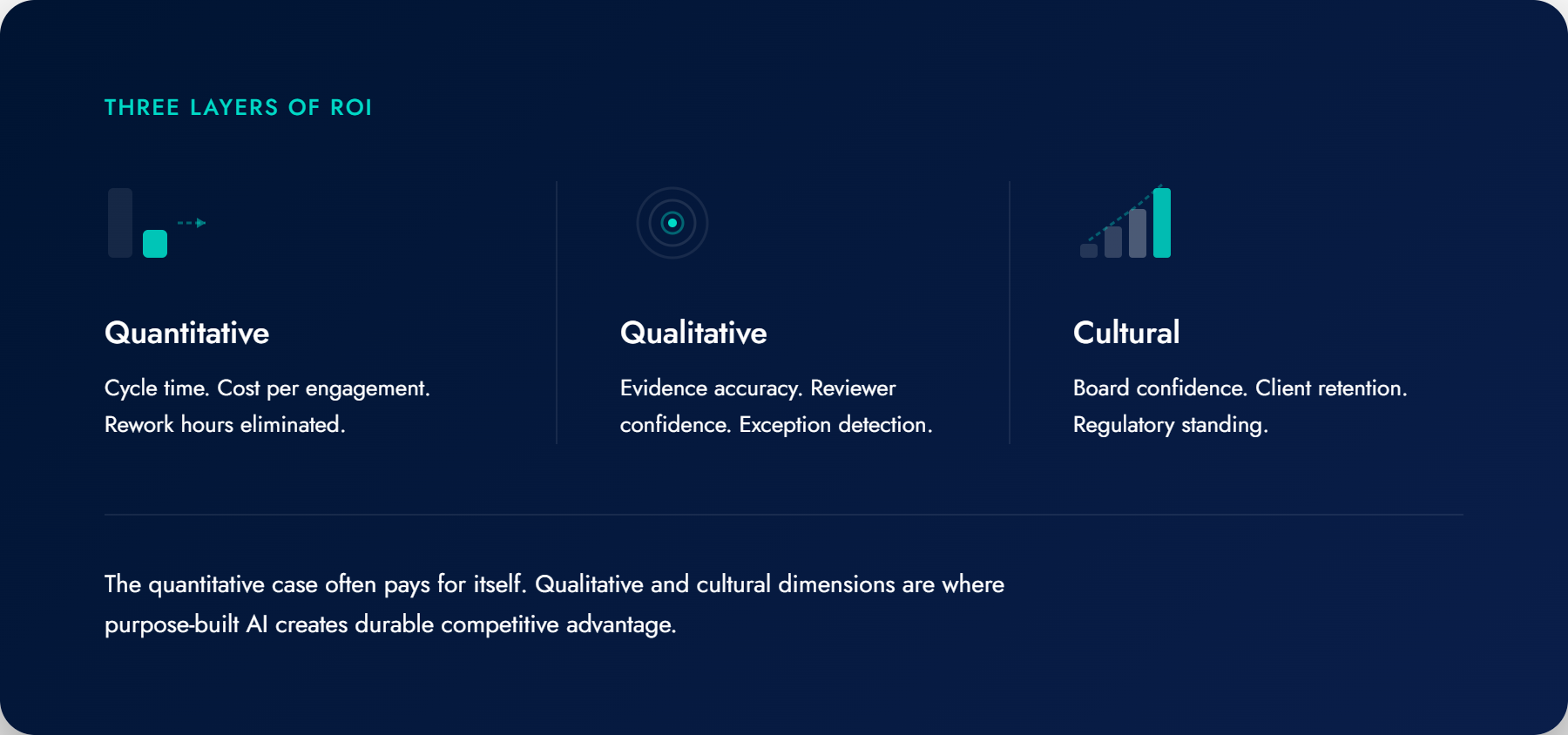
ROI dimension | What it measures | Example metrics |
Quantitative | Measurable cycle time and cost reduction | Accounts payable audit: 3 weeks to 1 day; rework hours eliminated; engagement cost per client |
Qualitative | Evidence accuracy and team confidence | Reviewer confidence scores; exception detection rates; compliance sign-off speed |
Cultural | Organizational credibility and assurance reach | Audit team perceived as strategic partner; board confidence in conclusions; insurance market positioning |
The quantitative case often pays for itself. The qualitative and cultural dimensions are where purpose-built AI creates durable competitive advantage, the kind that shows up in client retention, talent attraction, and regulatory standing.
The framework for making the decision: Build or buy AI?
Most firms land in a hybrid position: a purpose-built platform handles the engagement workflow, and custom build is reserved for the narrow set of capabilities that distinguish the firm in the market.
Decision matrix:
Capability type | Recommended approach | Reason |
Evidence collection and document extraction | Purpose-built platform | Commodity infrastructure, expensive to maintain, available better elsewhere |
AI-assisted testing and reconciliation | Purpose-built platform | Domain logic is already solved; rebuilding it is wasteful |
Client PBC management | Purpose-built platform | Workflow problem, not a differentiation problem |
Document Q&A across financial records | Purpose-built platform | Token efficiency is structurally better in purpose-built systems |
Firm-specific methodology enforcement | Build or customize | Proprietary, worth owning |
Proprietary risk scoring and analytics | Build | IP that wins clients and cannot be replicated by a peer buying the same software |
Industry-specific benchmarks or models | Build | Differentiation that compounds over time |
One legitimate argument for building internally: when AI is hosted inside the firm’s own environment, client data never leaves that environment. For firms handling highly sensitive material, this data sovereignty advantage is real and meaningful. The compliance burden still follows the system regardless of who built it, but the data control argument deserves weight in the decision.
The hard part of this framework is being honest about what is proprietary versus what feels proprietary because the firm built it first. In a nutshell:
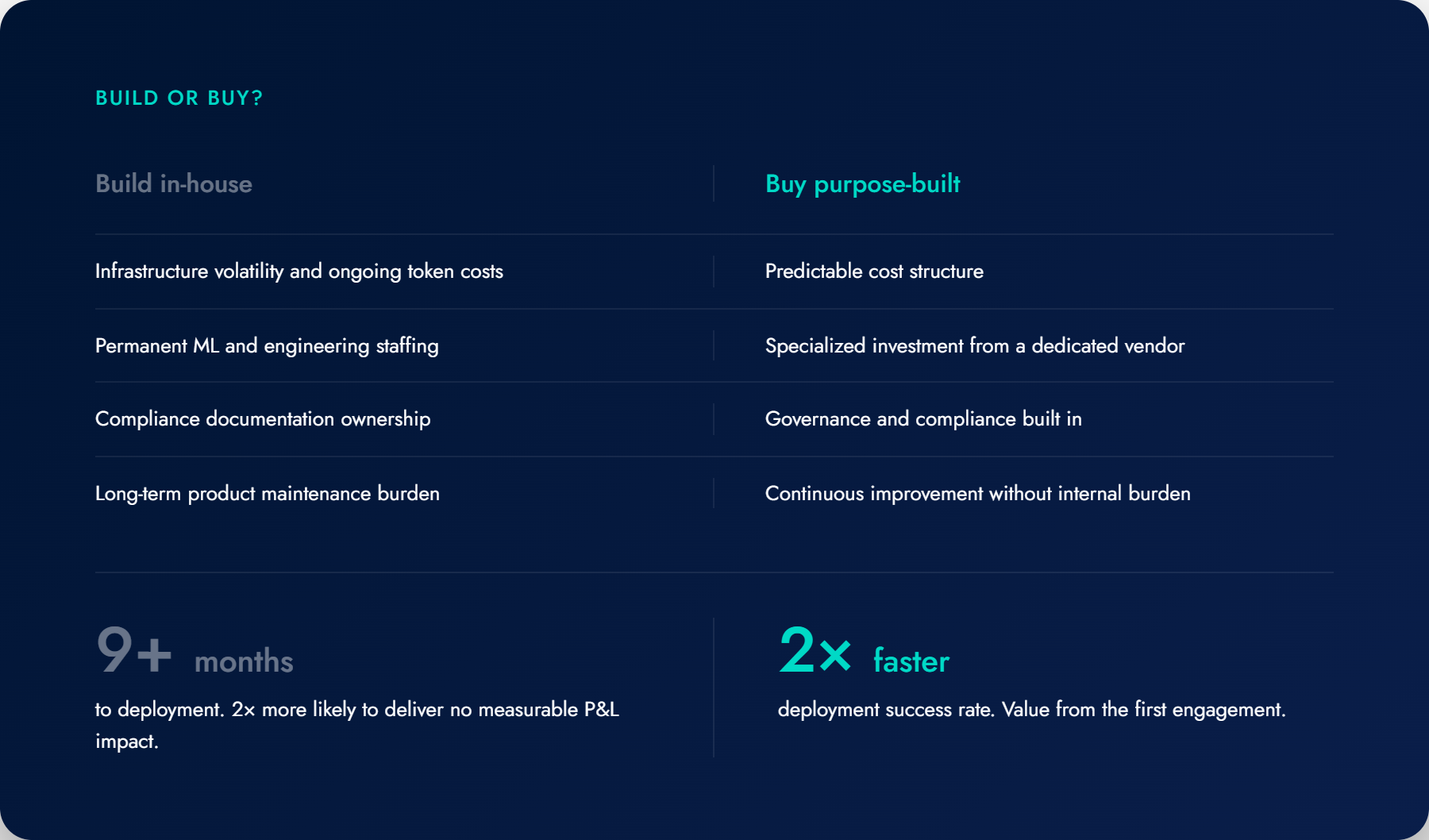
Objections around audit AI tech and how to address them
Objection | Response |
“Our audit management platform already does this.” | Audit management software handles workflow management. The traceable link between source document and audit conclusion is a separate capability, and the gap between the two is where purpose-built AI fills it. |
“We built something internally.” | Sustaining it is where most organizations hit a wall. Who owns it in three years, who retests it when the underlying model changes, and who is accountable when outputs are questioned in a regulatory context are harder to answer than the build itself. |
“We can use ChatGPT or Copilot.” | Generic AI tools answer questions but they do not execute procedures. They have no audit trail, no evidence anchoring, and no methodology enforcement. None of them produce defensible, traceable output. Every new generic tool also creates a new IT security and governance review. |
“AI will replace our audit team.” | Purpose-built audit AI moves teams from repetitive preparation to judgment and review. The extraction, matching, and exception flagging gets handled, so auditors focus on interpretation, client relationships, and strategic insight. The role becomes more valuable. |
“We need to evaluate this more.” | Extended evaluation carries a cost. Firms that have moved are compounding efficiency gains monthly. A structured pilot is a faster and more reliable path to the answer than continued review. |
Frequently asked questions
What is the average cost to build AI agents for an audit firm?
Year 1 total cost for a mid-to-large audit firm deploying AI agents across engagement workflows ranges from $1.1 million to $3.2 million, covering four phases: AI prototyping, core infrastructure and engineering, integration and testing, and enablement and training. This figure includes $390,000 to $890,000 in annual operating costs for staffing, LLM inference, and integration maintenance, which recur each year after.
Why do most internal AI builds fail to reach production?
The primary failure points are data readiness, governance complexity, and the gap between what a pilot demonstrates and what a production system requires. In audit specifically, the consistency and traceability requirements add complexity that general-purpose build frameworks do not anticipate.
What makes purpose-built audit AI cheaper per task than general-purpose tools?
Purpose-built audit AI places domain logic, document structure awareness, and workflow controls in the application layer rather than the prompt. The model does not need to interpret document structure, field relevance, or applicable standards on each call: that context is pre-handled. The result is significantly fewer tokens consumed per document processed and a lower, more predictable per-task cost at volume.
How long does it take to deploy AI built for audit and finance?
Deployment typically takes two to six weeks because governance, permissions, workflow controls, and domain logic are already built in. Internal builds take four to twelve months or more before the first user sees a working tool.
Who is accountable when AI-assisted audit output fails a regulatory review?
Is there any advantage to building AI internally?
One legitimate advantage: when AI is hosted inside the firm’s own environment, client data never leaves that environment. For firms handling highly sensitive material across multiple jurisdictions, that data sovereignty is a real and meaningful benefit. The compliance burden still follows the system regardless of who built it, but firms where data control is a core client commitment should weigh this carefully in the decision.
The decision in front of audit firms
AI is quickly becoming embedded in the software finance and accounting teams use every day. The firms that get the most out of that shift are the ones that deployed fastest, compounded capacity earliest, and kept engineering investment pointed at the work that actually distinguishes the practice.
The build-versus-buy decision is a capital allocation decision. The full cost picture, token economics, maintenance burden, regulatory accountability, and the opportunity cost of delay, deserves to be in the room before any proposal gets approved.
.png)


.svg?width=600&quality=70&format=auto&crop=16%3A9)