The Hidden Cost of AI in Audit: How Much are Firms Actually Paying?
.png?width=1400&quality=90&format=avif&crop=fit)
Key takeaways
- The proposal shows the implementation cost. What it typically omits is the variable cost layer that scales with adoption: token-based inference billing, model generation repricing, and the maintenance overhead that compounds with every release cycle.
- Token-based pricing scales with usage. As more auditors run more workflows through an AI system, the inference bill rises often faster than projected.
- Model generations reset pricing. A workflow priced on GPT-5 costs 24 times more on GPT-5.5 Pro. Budgets anchored to last year’s model pricing are already wrong.
- The organizations with the largest engineering teams and deepest capital reserves Uber, Salesforce, Shopify, Microsoft have all disclosed unexpected AI cost exposure at scale. Audit firms without equivalent infrastructure feel the pressure earlier.
- Purpose-built audit AI embeds domain logic in the application layer rather than the prompt, reducing token consumption per task and making per-engagement costs forecastable.
The cost of AI is not what it costs to start using it. It is what it costs to keep using it at scale, across a full team, through model upgrades, compliance cycles, and the steady expansion of what the system is asked to do.
Most AI budgets are built on the entry cost: the license, the implementation, the first few months of usage. The number that shapes the three-year financial picture is different. It is variable, it compounds with adoption, and it only becomes visible after the system is in production.
This article covers the cost layer that firms consistently undermodel: why token-based inference scales faster than most budgets anticipate, what maintenance demands after every model release, and how architecture determines whether AI costs stay forecastable or keep surprising the CFO.
The gap between what the proposal shows and what production posts
Most AI investment discussions center on implementation: the build cost, integration work, the enablement program. The number that dominates the three-year cost picture is the annual operating figure and it rarely appears in the proposal that gets approved.
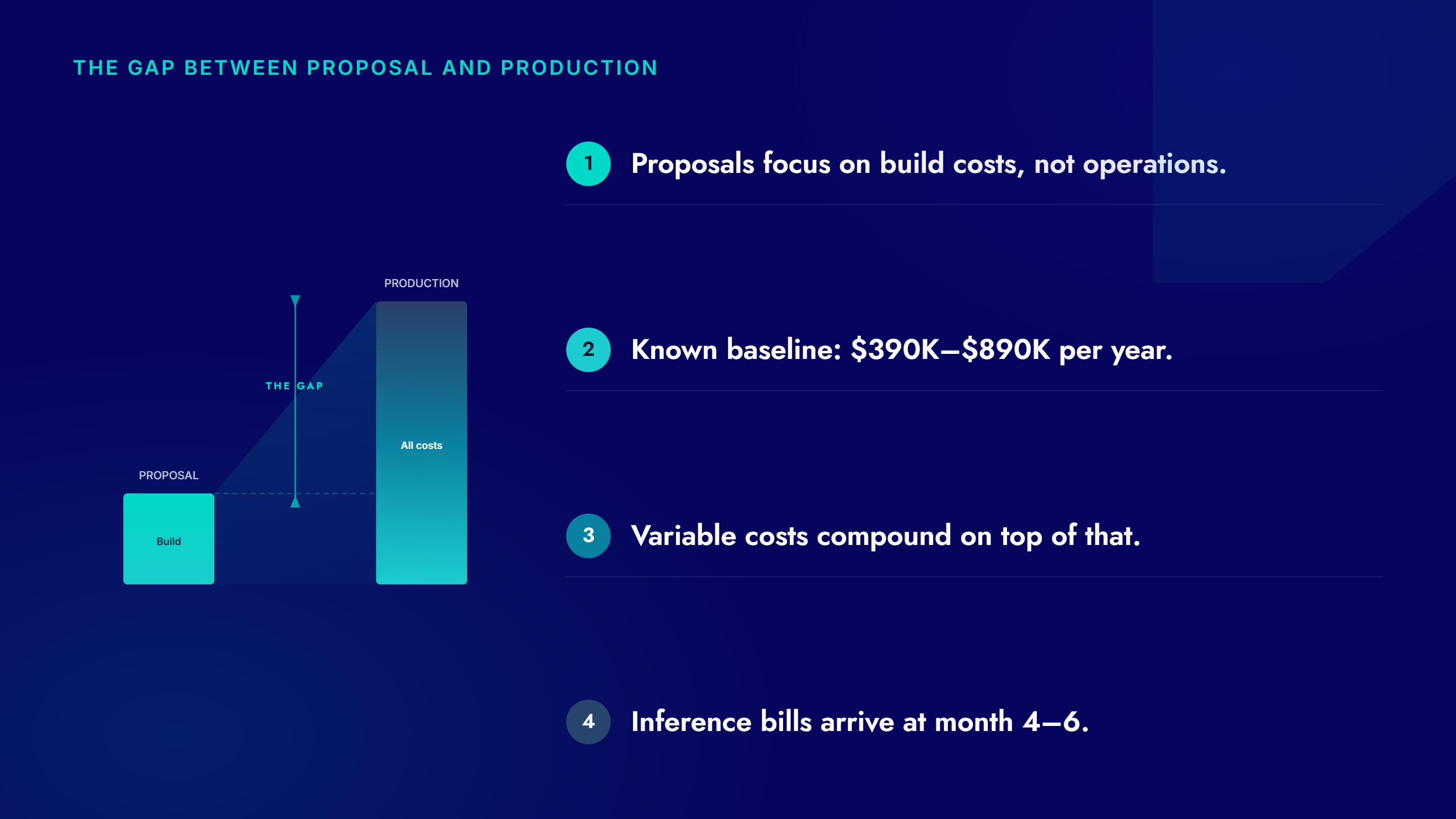
The costs this article is about sit on top of that baseline. They are variable, they compound with adoption, and they do not appear in any proposal because they only become visible after the system is in production.
The most significant of those costs and the one most consistently missing from first-year budgets, is inference. Token-based pricing means the bill grows every time usage grows, and resets every time the underlying model generation changes. Most firms find out what that means in practice around month four to six, when the first real-scale usage data arrives.
The token bill and why it's hard to forecast
LLM inference costs do not behave like software licenses. They scale with usage volume, shift with every model generation, and compound when adoption grows faster than anyone planned.
Token-based pricing means every query, every document extraction, every agent interaction consumes compute billed at the provider’s current rate. When usage is low, the cost is contained. When 50 auditors run hundreds of documents through an AI workflow each week, the bill reflects that multiplier.
Model generation changes compound the exposure. The entry-point model many firms built workflows on, GPT-5, ran at $1.25 per million input tokens and $10 per million output tokens. Current-generation models have moved substantially from that baseline.
Model | Input (per 1M tokens) | Output (per 1M tokens) |
GPT-5 | $1.25 | $10.00 |
GPT-5.5 Pro | $30.00 | $180.00 |
Anthropic Mythos | $25.00 | $125.00 |
A workflow priced on GPT-5 costs 24 times more on GPT-5.5 Pro. Firms that anchored their cost models to an earlier generation are not working from a current number. A SaaS subscription has a ceiling. Inference costs do not.
The real-world examples from enterprise deployments make the exposure concrete:
- Uber burned through its entire 2026 AI coding budget in four months.
- Salesforce committed $300 million in Anthropic tokens for 2026 and is now evaluating routing work to cheaper models.
- Shopify told investors that gross profit took a direct hit from LLM costs.
- Microsoft cancelled most of its Claude Code enterprise licenses after token consumption exceeded what flat-rate budget modeling had anticipated
These organizations carry engineering teams, capital reserves, and technical infrastructure that most audit firms do not have. The exposure arrives at the same time, it just arrives with less runway to absorb it.
The question any firm should put to any AI vendor or internal build team before signing: what model generation does this pricing assume? If the answer reflects a rate from 12 months ago, the number needs recalculation.
How maintenance costs compound after go-live
The first model upgrade arrives three to five months after deployment. The provider releases a new generation, deprecates the old pricing tier, and your workflows now run on a model they were never calibrated on.
That triggers a re-prompting cycle. The outputs your team spent weeks calibrating need to be verified again. Some workflows drift. Some break. The engineer who built the original logic is now doing regression testing instead of shipping the next feature.
This repeats every time a model provider releases a new generation - on their schedule, not yours.
For a firm that spent $1.5 million on the initial build, that is $225,000 to $450,000 in ongoing maintenance per year, before any new development. Month 12 looks different from month 6, and month 24 looks different again.
Every new feature request from the engagement team, compliance documentation update and security review cycle adds to that load. The engineering capacity required to hold the system at its launch-day quality level is not what most firms modeled when they approved the initial budget.
The firms that manage this well are the ones that treated the post-go-live resourcing as a line item before the build started. The ones that did not tend to discover the gap when the system starts underperforming and there is no one on the team with the mandate to fix it.
Why agentic AI amplifies every cost category
Single-step AI tasks, summarize this document, flag this transaction, carry manageable and predictable token costs. Agentic workflows, where an AI model plans, executes multiple steps, and calls tools in sequence, consume tokens at a different scale.
A single agentic task can exceed one million tokens, depending on reasoning depth, tool calls, and retry loops. When firms build or adopt agentic systems without modeling that consumption, the inference bill from a week of engagement work can exceed a month’s budget projection.
The audit workflows where agentic AI delivers the most value multi-step evidence gathering, cross-referencing across large document sets, iterative reconciliation are also the ones with the highest token footprint. That trade-off is not a reason to avoid agentic AI. It is a reason to model it before deployment rather than after the first bill arrives.
How purpose-built architecture makes AI costs forecastable
The volatility that makes AI costs hard to manage comes down to where domain logic lives.
General-purpose AI: the model does all the interpretive work on every call.
Retry rates | Failed outputs trigger re-runs, each billed separately |
Prompt length | More context per call means more tokens consumed |
Output consistency | Unstructured responses require downstream correction |
Purpose-built audit AI: domain logic sits in the application layer, not the prompt.
- Document structure is pre-handled before the model sees it
- Workflow controls constrain what the model is asked to do on each call
- Prompts are structured and consistent across every execution
- Output arrives in the format the downstream workflow expects, with no additional iteration
At the document volume a mid-size firm runs annually, that gap is the difference between a cost line that holds and one that requires explaining to the CFO.
The pricing model reinforces the difference:
Token-based (general-purpose) | Grows with every user, engagement, model upgrade. No ceiling. |
Per-seat or per-engagement (purpose-built) | Fixed ceiling, forecastable regardless of usage volume |
Firms using general-purpose AI tools, whether from an API, a license, or a browser, carry the token-based cost model whether they planned for it or not. The question after go-live is whether the cost structure is one the firm can forecast, or one it can only report on retroactively.
Six questions to ask before you commit to any AI path
"A general-purpose model applies the same processing power to every task, so you pay for capability the workflow does not need. A purpose-built tool selects the right model for each step, which is how you get accurate output at a cost you can forecast in advance rather than reconcile after the fact."

Erick Moakley
Product Lead at DataSnipper
That framework applies whether you are evaluating a vendor or scoping an internal build. Either path should be able to answer the following:
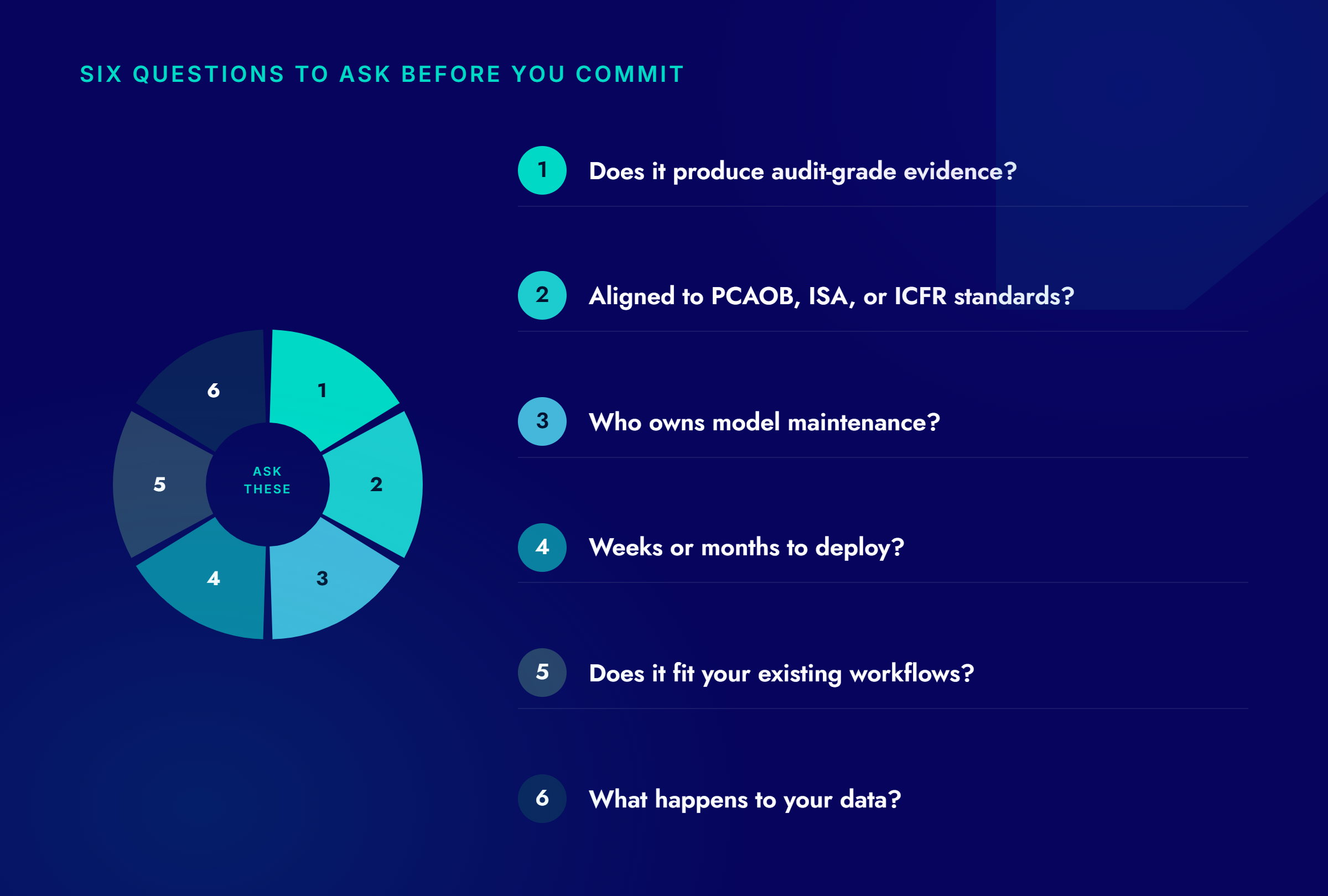
- Does it produce audit-grade evidence with direct traceability to source documents? A workpaper has to survive review. If the tool cannot tie every output back to the source document, someone on your team rebuilds the trail by hand.
- Is it aligned to PCAOB, ISA, or ICFR standards out of the box? Built-in alignment saves the work of retrofitting compliance after deployment. If it is missing, that work falls to your team.
- Who owns model maintenance when the underlying AI changes? Models get deprecated and repriced without notice. Know whether your team or the vendor handles the retest and swap each time a new generation releases.
- What does deployment look like weeks or months? A long rollout burns budget before you see a result. Ask for a real timeline, not an optimistic one.
- Can it operate inside your existing workflows? If the team has to leave Excel to use it, adoption stalls. The tool should meet the work where it already happens.
- What happens to your data? Audit data carries retention and confidentiality obligations. Ask where it is stored, how long it is kept, and whether it is used to train models outside your environment.
If you are building, you have to answer all six yourself. That is the quiet cost of ownership that most plans leave out.
What to put in front of your CFO
The question is not whether AI produces a return. Most deployments do, once the costs are correctly modeled. The question is whether the cost model is built on assumptions that will hold through the next model generation, the next 12 months of usage growth, and the next compliance documentation cycle.
Three areas to model before any AI commitment:
- Inference costs at scale. What is the current token rate for the model this system runs on? What happens to that figure if usage doubles? What happens if the provider releases a new model generation and older pricing tiers are deprecated?
- Staffing beyond year one. Who maintains this system in year two and year three? Is that person already on headcount, or does the firm need to hire? Does the proposal account for that cost, or is it assumed away?
- Upgrade and compliance cycles. How often will this system require re-prompting, regression testing, or security documentation updates? Which internal team owns that work, and what is their current capacity?
These are not complex questions. They are questions that most AI proposals do not answer directly and that most approvers do not ask until the bill arrives.
Frequently Asked Questions
What are the ongoing costs of running AI in an audit firm after go-live?
The ongoing cost structure breaks into two layers. The structured layer, staffing, infrastructure, integration maintenance, runs $390,000 to $890,000 annually for custom-built systems. On top of that sits the variable layer: token-based inference costs that scale with usage and reprice with every model generation. It is the variable layer that firms consistently undermodel in the first year.
Why do AI costs increase after adoption?
Token-based billing scales directly with usage. As more auditors run more workflows through a system, token consumption and the associated bill rise accordingly. Model generation upgrades also reprice existing workflows: a task priced on GPT-5 costs 24 times more on GPT-5.5 Pro. Firms that built their cost models on a previous model generation are operating on the wrong baseline.
What makes AI costs unpredictable for audit firms?
Three factors drive unpredictability: usage-based billing that scales with adoption volume, model pricing that resets with each generation, and maintenance work that grows with every release cycle. Firms that budget for licensing but undercount staffing and inference consistently encounter mid-year cost surprises.
What is the difference between agentic AI and single-step AI in terms of cost?
Single-step AI tasks, summarize, classify, extract, carry contained and reasonably forecastable token costs. Agentic workflows, where the model plans and executes multi-step tasks with tool calls, can consume more than one million tokens per task depending on complexity and retry behavior. Audit workflows that benefit most from agentic AI tend to carry the highest token footprint.
How does purpose-built audit AI reduce ongoing costs?
Purpose-built systems place domain logic in the application layer rather than the prompt. The model processes less per task, consuming fewer tokens per document. The efficiency difference runs 5 to 7 times at the task level. Across annual document volumes, that gap separates a cost structure that scales manageably from one that surprises the budget mid-cycle.
What should a firm ask a vendor before signing an AI contract?
Three questions: What model generation does this pricing assume, and what happens to costs if the provider releases a new generation? Who owns ongoing maintenance after go-live, and is that person on your headcount? How does the contract handle model upgrades and the re-prompting work they require?
The bill that arrives six months after go-live is not a surprise for firms that modeled the full cost picture before signing. It is a surprise for firms that modeled the proposal.
Getting the picture right means accounting for token economics, maintenance staffing, model upgrade cycles, and the compliance overhead that follows any AI system regardless of who built it. Those costs are not hidden because they are obscure. They are hidden because proposals rarely include them.
.png)

.svg?width=600&quality=70&format=auto&crop=16%3A9)